

Experience Feeds Perspective
...but is that experience a launch pad or a rocket stage whose fuel is spent?

After pulling free from a three-year battle with inflammation, I am finally feeling well enough to face, head-on, my 70th birthday later this year. (Damn, did I just write that down where everyone could see? My Aunt Anne is rolling over in her grave.) The responsible thing would be to jettison the detritus accumulated in former stages of my life. No one wants to croak and then watch from the Other Side while one’s progeny throws the remnants of one’s life into a bonfire. Especially when one’s own forebears already left enough scrapbooks, photos, and letters behind to fill one’s basement.
I have no desire to hoard. I love a clean line through my basement as much as I love a clean, purpose-driven sentence in my writing. The problem is that each of the items I pick up contains a story. For a storyteller like me, discarding it can feel like selling off your own connective tissue.
In one office drawer, for example, I have thick piles of newsletters I wrote and designed for our regional arts council in the 1990s and 2000s. They contain interviews with so many talented creatives that so far, I’ve only managed to toss out duplicates. I just opened that drawer the other day to find an article for which I’d interviewed executives in large corporations. I was curious about whether experience in the arts could be a valuable inclusion on a business resume. The following quote was from a former vice president of product design and development at Black & Decker who was also a painter. He was also my dad, John W. Graham.
The characteristics of artists that make them uniquely useful in various business functions would be imagination and creativity, the ability to abstract concepts from one context and reapply them in a totally different context, sensitivity to the human condition, the ability to perceive patterns and trends, the ability to integrate, and an inclination to experiment. As concerns strategic planning, there have been several studies that show that artistic people tend to be the most accurate predictors of future events.
Additional attributes include an appreciation of aesthetics, creating a work environment that is conducive to innovation, an ability to learn through failure, and a willingness to pivot when concerted efforts fail to achieve a desired result. Since I work for myself and my boss can be really hard on me, it’s good to be reminded of my useful qualities.
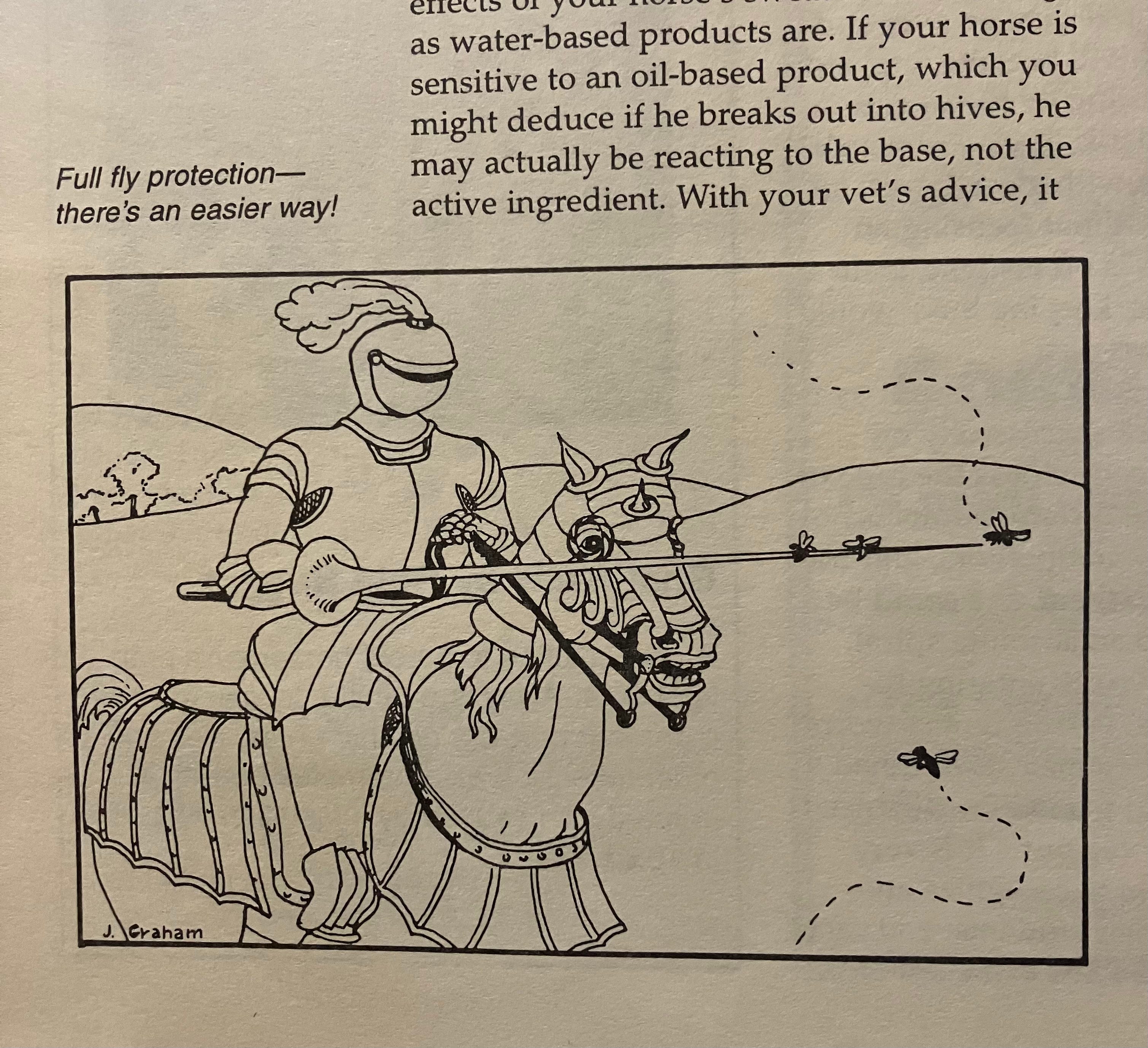
Beside them are similar stacks of newsletters I created for tack shops. They’d be easier to get rid of, you’d think, considering my life on the farm is over, except that they contain horse-themed cartoons my father created. For me, collaborating on those illustrations was a highlight of our relationship.
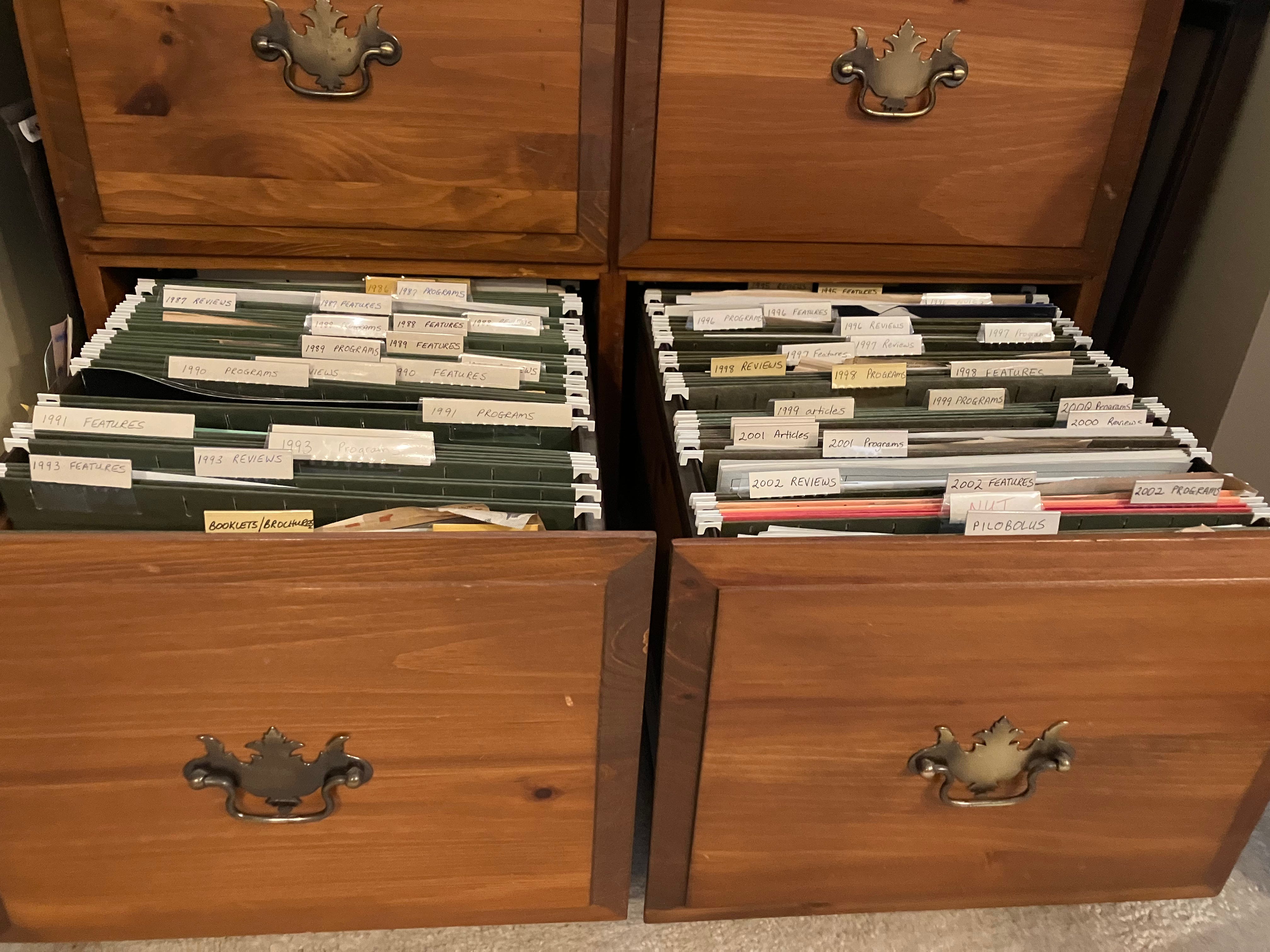
I have two deep file drawers containing 19 years of feature articles and reviews I wrote as a dance critic for The Morning Call newspaper in Allentown, PA.
Without easy access to those dance reviews, I may have missed the way they were a launchpad in perspective for my guide for writers, Crafting Story Movement. Seeking inspiration, my review of Danny Buraczeski’s Jazzdance company from 2002 reminded me of how movement onstage can impel prose on the page:
All choreographers create visual language. With scoops, twists, arcs and suspensions, Danny Buraczeski creates his language in cursive writing. Carving meaning into the dance space with body parts motivated by inherently dramatic swing movements, the heroes of Buraczeski’s dance literature reach for an apex, suspend there, then swoop down to the floor to rise again. By the end of the evening, Buraczeski’s movement signature is all over the stage.
Some of my feature articles from those years contain wisdom I’d be loath to lose. In 1997 I interviewed Michael Flatley—remarkably, on his end, via brand-new cell phone technology as he was transported by limousine from New York to Philadelphia (note: this is not how dancers typically travel). I asked the “Lord of the Dance” star why he embarked on life as a dancer when his high IQ was so high that Mensa had been courting him for membership. If he could be just about anything, why did he choose to be a dancer? He answered in his musical Irish lilt, “Because I love it with all my heart. Everyone should do, I believe, what they love to do, and anyone who is intelligent is doing that.” That answer has sustained me during periods in which my writing could also have been called my “under-employment.” Not everyone wakes up in the morning loving their life the way I do.
Piled on other shelves are journals and multiple versions of full novel manuscripts. Whether abandoned or eventually published, they remind me that no one spits out a finished novel in the first draft. An effective story can take layers (and layers!) of effort. A reminder that I haven’t gotten here alone, those pages are covered with the handwriting of the advanced readers whose feedback became my earliest education in how to write a novel. Their comments represent dozens of hours of effort.
While I will not digitize all these materials, I can’t quite bring myself to toss them without my hand starting to twitch. They represent a 43-year evolution in my thought life. They are the rocket fuel that propelled me beyond my familiar orbit and toward the stars I’d been reaching for. Yet no one will be interested in all that process after my death. The resulting perspective is now contained in my novels, a few chapters I wrote for Writer’s Digest books, and my craft book.
So, decision made. After I hit send I’ll apologize to my kids for leaving behind this ponderous inheritance. And they may yet have a use. Because my medium is paper, these materials will make a great bonfire. And what greater legacy can a mother leave behind than a tangible expression of her warmth?
[Just don’t tell them that Michael Flatley, who is two years younger than I am, is worth $50 million, okay?]
Love this, Kathryn! I go through the same journey each time I go through old notebooks and papers....
I'm so glad you are feeling better, my friend. You have so much to deal with- both the wonderful and the exhausting. I wish you continued healing and peace and a cruise into this milestone birthday!
I have a shelf of journals over my writing desk. I used to keep them piled in a storage bin, certain at some point I'd relegate them to a bonfire, but I just can't bring myself to do it. So I now see them as evidence of a life lived each time I'm in my office. I never reread them and I have no children to leave them to, so at some point they may go the way of that bonfire. But for the moment, there they are... Photo albums same same. What to do... something to think about after retirement, but I do weigh the weight of carrying these around vs the sentimentality of memories...